Abstract
This paper proposes a new, independent blockchain to operate at the core of Web 3. Powered by a new consensus mechanism, Satoshi Plus, Core is a Turing-complete blockchain leveraging the Bitcoin mining hashrate and the Ethereum Virtual Machine (EVM). Satoshi Plus applies a protocol-driven validator election mechanism to combine the optimal features of Proof of Work (PoW) and Delegated Proof of Stake (DPoS) in order to ensure the maximization of security, scalability, and decentralization.
Introduction
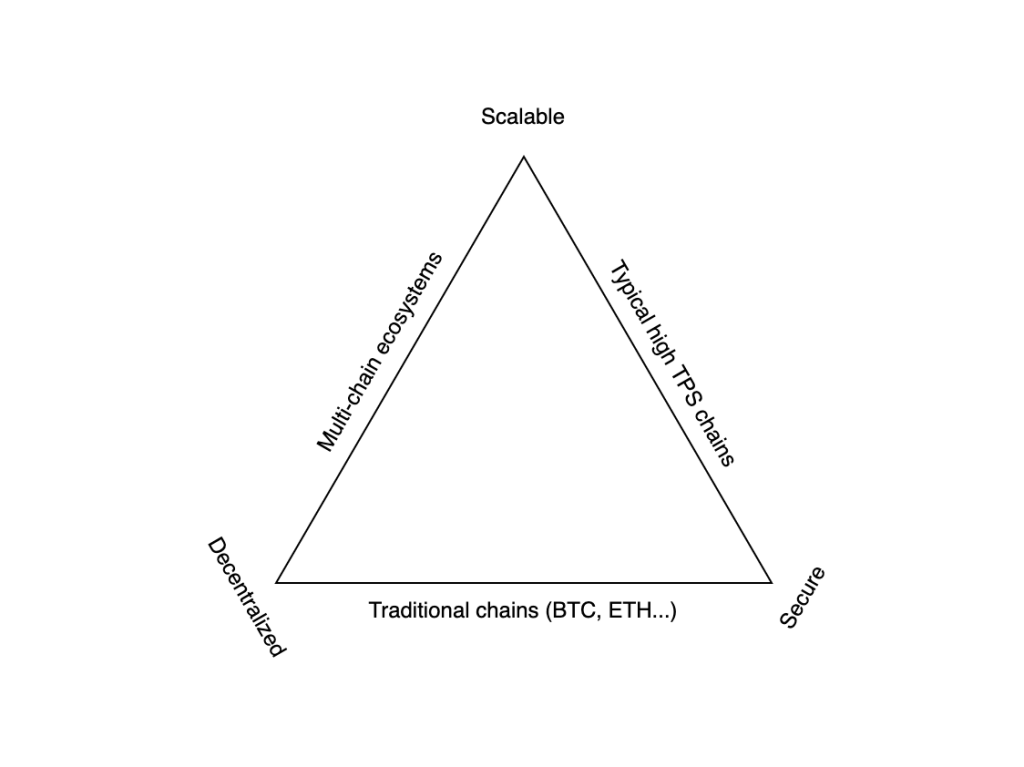
The Blockchain Trilemma is a well-studied problem by both academics and market participants. It states that all cryptocurrencies, including Bitcoin, Ethereum, etc. must make trade-offs between optimal security, scalability, and decentralization, often prioritizing two elements at the expense of the third, as demonstrated in Figure 1, Our solution to the trilemma above is Satoshi Plus consensus, which operates at the core of the Core Network. Satoshi Plus consensus combines Proof ofWork (PoW) and Delegated Proof of Stake (DPoS) to leverage the strengths of each while simultaneously ameliorating their respective shortcomings. Specifically, Bitcoin computing power guarantees decentralization, the DPoS and leadership election mechanisms ensure scalability, and the entire network holistically maintains its security. Core is the first chain to implement our new consensus mechanism. Although it will not be the last, we believe that with the strength of our community, CORE will achieve the necessary network effects required to create a successful currency and serve as the much needed springboard for broader Web 3 adoption.
The rest of the paper is organized as follows. First, we compare the tradeoffs made by other L1 and L2 networks. Next, we dig deeper into Satoshi Plus consensus and its various components. We then discuss the security properties and future directions for the Core network. We then discuss the base layer currency of the chain – CORE. Finally, we discuss the governance of the Core network via the Core DAO.
Bitcoin
In 2009, Satoshi Nakamoto carved scarcity out of the stone of abundance. Despite its enablement of infinite replicability, the internet could now have its own native currency on the blockchain: Bitcoin – the first truly digital solution to the problem of money [Nak]. Bitcoin introduced PoW mining to the world, allowing anyone with compute power to participate in securing the network. Leveraging Nakamoto consensus, Bitcoin has become the most decentralized blockchain, but with only 7 TPS, it lacks the scalability [Aut] necessary to transition beyond “Store of Value” use cases. BTC’s role as “digital gold” is unquestioned, but as the hype around the Lightning Network illustrates, many in the Bitcoin community want more.
Ethereum
The most popular dapp platform and the first Turing-complete blockchain [Buta]. The abstractions offered by the Ethereum Virtual Machine (EVM) and the popular Solidity programming language allowed hundreds of thousands, if not millions, of developers to build decentralized applications for the first time [She], which has given rise to DeFi, Play2Earn, NFTs, etc. Ethereum offered a higher TPS than Bitcoin at the expense of some decentralization, but even with its 15 TPS, major scalability bottlenecks remain [Fri].

 Online Treasure